Valkyrie: The Story of the Plot to Kill Hitler, by Its Last Member by von Boeselager Philip Freiherr
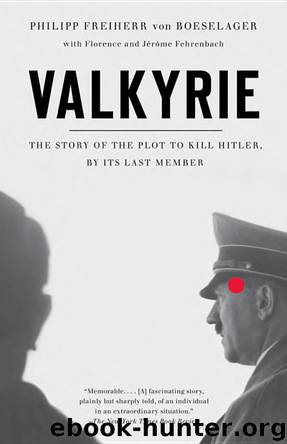
Author:von Boeselager, Philip Freiherr [von Boeselager, Philip Freiherr]
Language: eng
Format: epub
Tags: Non-Fiction, History, Biography
Goodreads: 7791998
Publisher: Vintage
Published: 2010-06-01T06:00:00+00:00
13
When Horses Make Meetings Easier
1943
The German army had never ceased to use horses in support of the artillery, to substitute for failing machinery on the Russian front, and to aid bogged-down supply columns. Mobile and resilient, horses were often more reliable than motors, and despite exhaustion from the long marches made since summer, they continued to serve numerous purposes. The animals provided for the mounted cavalry could, at a trot, advance at sixteen kilometers an hour, and draft horses at thirteen kilometers an hour. The cold did not take them by surprise. Whereas the men tried to pad their thin uniforms with paper and rags, the horses’ hair thickened naturally, becoming almost like fur, to our great astonishment. When hay and oats began to run short on the immense, snowy plains, the horses reacted by tearing off the tenderest branches of the pine trees. They even chewed on the edges of the cottages’ thatched roofs when they could reach them. Finally, they developed the habit of sucking icicles for water. Their adaptability was phenomenal.
For the cavalrymen, the horse was a home away from home. Our mounts carried our personal effects (clothing and other articles, toiletries) and the tents—each horseman carried a quarter of the latter. And what tender caresses the men and their animals exchanged after a battle! Obviously, we horsemen were linked by camaraderie, a pact of mutual aid, and the certainty that even if they remained silent, our fellows understood and supported us. But the animals—their hair, their moist muzzles, their shivers—paradoxically provided us with a physical intimacy, a warmth, that we could not allow ourselves even among our best comrades. In the extreme severity of war, the men confided in their horses, depended on them. The horse, for its part, was incapable of surviving without its master’s care. And in the end it is hard to say which was the more useful to the other, the horseman or the mount.
For a long time my brother Georg had been thinking about how to harness the tactical potential of the cavalry. On this immense front, it was not firepower and the abundance of matériel alone that would decide the outcome. Furthermore, in such respects, the German army did not have the advantage. With an industrial base damaged by the Depression and now handicapped by air raids, it would never be able to produce as many artillery shells and munitions as it had in 1917. It would never succeed in challenging the superiority of an enemy that the United States had begun providing with armaments. Nor would human resources be able to turn the war around. By this fifth year of the war, those born between 1915 and 1925 had already been decimated. It would be necessary to call upon younger and younger recruits who were hastily trained. The rotation of troops was particularly tragic in the infantry. To sow disorder among the adversary, close the breaches, and cover our retreat, what we needed was mobility, quick reactions, and a more economical use of matériel.
Download
This site does not store any files on its server. We only index and link to content provided by other sites. Please contact the content providers to delete copyright contents if any and email us, we'll remove relevant links or contents immediately.
Fanny Burney by Claire Harman(26605)
Empire of the Sikhs by Patwant Singh(23089)
Out of India by Michael Foss(16856)
Leonardo da Vinci by Walter Isaacson(13339)
Small Great Things by Jodi Picoult(7151)
The Six Wives Of Henry VIII (WOMEN IN HISTORY) by Fraser Antonia(5518)
The Wind in My Hair by Masih Alinejad(5100)
A Higher Loyalty: Truth, Lies, and Leadership by James Comey(4965)
The Crown by Robert Lacey(4818)
The Lonely City by Olivia Laing(4804)
Millionaire: The Philanderer, Gambler, and Duelist Who Invented Modern Finance by Janet Gleeson(4481)
The Iron Duke by The Iron Duke(4365)
Papillon (English) by Henri Charrière(4277)
Sticky Fingers by Joe Hagan(4204)
Joan of Arc by Mary Gordon(4116)
Alive: The Story of the Andes Survivors by Piers Paul Read(4035)
Stalin by Stephen Kotkin(3971)
Aleister Crowley: The Biography by Tobias Churton(3642)
Ants Among Elephants by Sujatha Gidla(3468)
